
When I entered academia, I began using the name given to me by my grandmother. “Aurora” was always my name, I just took time in claiming it.
I am research scholar at the Ronin Institute where I look at the transformational capacity and resilience of socio-ecological systems.
I obtained her Masters of Environmental Management at Western Colorado University, focusing on sustainable and resilient communities, and am a California naturalist.
I have over 15-years working with a variety of tribes and cultures from around the world. I am a generalist in that I think systems, and can understand most subjects at a depth that allows me to excel in building bridges between diverse groups and stakeholders.
I have a background in restorative justice, project management and development, conflict resolution, regenerative agriculture & systems, holistic management, climate action plans and community action based research, community planning process models, wildlife biology, and storytelling.
I have also has taught extensively in academia.
My work focuses on understanding the emergences of the psycho-social fabrics that underlies all communities around the world and how this relates to the design and construction of systems. I look at landscapes of human consciousness into the creations of the systems of the built environment and management of the natural world.
I am the creator and host the Women of Regenerative Ag series done in a joint venture with Soil4Climate.
I worked for many years as a cultural liaison, regenerative systems consultant, and facilitator for community dialogues and planning-working to unite and harness our human capacity to create as a collective.
Broto Conference Affinity: A conference about the intersection of Art-Climate-Science and Nature, Dec. 5 & Dec. 12, 2020
Broto Conference Affinity explores the intersection of art, climate science and nature for solutions.
Our focus was on the following:
“What is the societal/cultural reboot that is more in sync with nature? We'll engage our eco-intelligence experts to explore the how and the why we became estranged from nature as a culture.”
“Merging the most diverse perspectives yields the richest synthesis of ideas. New urgency. New ideas. New boundaries.”
– The Broto Credo

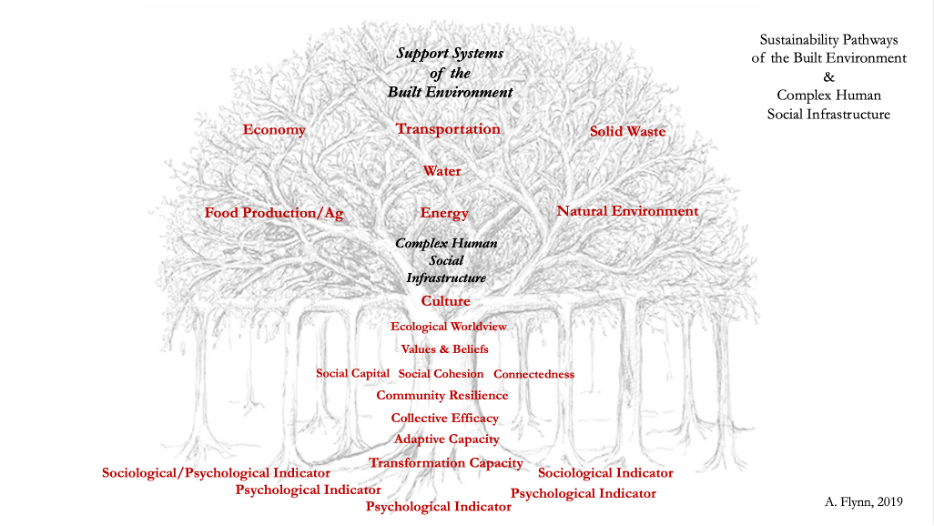
“My applied and theoretical research focuses on community and ecosystem resiliency, adaptive capacity, and transformational capacity of socio-ecological systems. My research centers on five select cross-cultural sociological and psychological indicators that multidisciplinary research suggests are the emergent drivers behind these concepts including the proliferation of sustainable development itself. Mv applied research was done within the context of climate action planning for a higher education institution, whereby I evaluated and assessed correlations of these cross-cultural indicators to the institution's greenhouse as emission footprint and mitigation efforts. These indicators were then increased with a 5-week training program I designed for "transformational learning" where we explored across multiple fields of study concepts to do with identity self, culture, cognition, communication, transformation of the self, perception, trauma, self-directed neuroplasticity, and emotional awareness. This enabled a shift in the participant's perspective of their subjective realities, identities, implicit biases, and limiting beliefs, all of which potentially keep community from interconnecting and moving forward powerfully in a transitionary process towards sustainability.”
UNESCO
The Climate Crisis Comes Home: An Interview with Aurora Flynn, part 1
-with Nathan Stevens
“Research and theory only stay in their books until the crisis they reveal burns down your house. Aurora Flynn is a climate researcher who saw first hand the destruction warming temperatures can unleash. While working in California, Flynn had to flee the 2019 fires that swept the state, mirroring the all consuming flames that captured the world’s attention in Brazil and Australia. Flynn saw a breakdown around her that further proved her thesis: climate change must be met with compassion and transformational change of both the individual and society. We speak with the Ronin scholar and founder of the Ouroboros Agency about her experiences.”
-Nathan Stevens, UNESCO Crossings Institute & University of Oregon
Transformational Change and the Climate Crisis: An Interview with Aurora Flynn, part 2
“In our second interview with Aurora Flynn, we discuss the nuts and bolts of transformational change and how current capitalist systems stymie the individual’s ability to meet the climate crisis and grow stronger.”
-Nathan Stevens, UNESCO Crossings Institute & University of Oregon
The Women of Regenerative Ag Interview Series
Transforming the Health of the Soil, Land & People
This is a platform for the extraordinary women leading the regenerative agricultural movement—and the transformation of our societies--around the world. They are on the ground, creating critical shifts in seemingly intractable and highly unsustainable systems. And they've been doing so for a long time.
In this series, we look to explore beyond the soil, to the underlying theme of transformation itself, across size, scale, and multiple dimensions: from that very internal landscape of the human consciousness to the outer manifestation in the world around us, be it in the form of agricultural management practices, tools and techniques, to culture, economics, policy, and the built environment.
This series is a joint venture with Soil4Climate and the Ouroboros Agency, where we work to help transform the human social infrastructure, and the built environment, to create truly resilient and regenerative societies.
These recordings originally aired as interactive livestream interviews on social media. They were held during the initial months of the USA Covid lockdown and due to limited facilities, we sometimes had to get creative with our locations.
Please enjoy these incredible women.
Precious Phiri is a small holder farmer, regenerative agriculture practitioner and trainer based in Zimbabwe. She is an accredited Field Professional for Holistic Management Education for Communities by the Savory Institute. She works with rural communities through her organization EarthWisdom, as well as other partners both in southern and east Africa to regenerate degraded communal lands. Precious is the African Coordinator for Regeneration International and is a part of their steering committee. Her role is to connect with other regenerative work going on in the African region, to continue bringing this work to the global movement.
Highlights of this episode include:
1. The impact of Covid on Zimbabwe and how the communities are managing.
2. Why holistic management requires a shift in consciousness and is not regenerative/high impact grazing.
3. The art of cohesive communal planning within diverse patriarchal cultures & tribes.
4. Why evoking power, honor, and nobility from a community is vital to creating their lasting sovereignty.
5. Why the biggest blockage in the regenerative movement is actually professional and institutional egos.
Amber Smith,
dir. Women in Ranching
Amber Smith the program director of Women in Ranching for the Western Landowners Alliance. Women in Ranching provides transformational space for women to support human synergy around re-envisioning what is possible in agriculture. Amber has been ranching in rural communities for 14 years with her husband and two young children. They currently steward 53,000 acres known as Antelope Springs Ranch in eastern Montana. Amber’s passion is rooted in building a future where rural families thrive, and all people are empowered and supported in pursuing work that aligns with their personal goals and deeply connects them to their community. Her time studying in the Middle East, and six years as Activity Director for a rural nursing home, helped her develop a unique passion for creating spaces of dignity, joy and acceptance.
Highlights of this episode include:
1. Her origins and the management strategy utilized on their operation
2. The bottlenecks of distribution and slaughterhouse access and why efficiency and high productivity create the “externalities” of social and ecological injustice.
3. Why transformation needs allies, strategy, and how intergenerational transmissions can actually hinder the process.
4. Why dynamics in a social fabric can stop progress, and why a sense of belonging and connection to self, community and the land is paramount for regeneration.
5. Why authenticity and openness about the human journey is critical for emotional development, wisdom and systems thinking.
Misty West Gay
Freestone Ranch, CA
Misty West Gay is a mom, poet, gardener, herbalist, and regenerative rancher. She and her husband Jonathan own Freestone Ranch in northern California. They are a certified Fibershed Climate Beneficial Producer and are a member of the American Grassfed Association. Misty is also a member of the Sonoma County Food System Alliance. Following a stint doing Internet software production and technical writing, back when those things were fun, she circled back to her first loves: poetry and trees.
Renata Brillinger
CalCAN
Renata Brillinger is the co-founder and Executive Director of the California Climate and Agriculture Network (CalCAN). She has more than two decades of experience in sustainable agriculture policy and programs and 30 years’ experience in non-profit administration. She serves on the steering committee of the Center for Sustainability at CalPoly University in San Luis Obispo and the advisory board of UC Davis Agricultural Sustainability Institute.
Highlights of this episode include:
1. The history and function of CalCAN.
2. Why the dominant culture in California legislator must shift.
3. Regenerative agriculture vs climate smart ag.
4. The 2020 Farmer Equity Report.
5. Why food from local farms and ranches not yet served at scale in schools, public institutions, throughout the CA prison system.
6. The House Select Committees Climate Crisis report, Biden’s Unity Taskforce, and why a methodology matters for carbon footprint accounting in these reports.
7. Why doing what you love is what you are here to do.
8. Why political leadership and campaign finance reform are paramount for regenerative ag to flourish
Winona LaDuke
Winona LaDuke, is a rural development economist working on issues of economics, food, and energy sovereignty. She lives and works on the White Earth reservation in northern Minnesota, and leads several organizations including Honor the Earth, Anishinaabe Agriculture Institute, Akiing, and Winona’s Hemp. These organizations develop and model culturally-based sustainable development strategies utilizing renewable energy and sustainable food systems. She is an international thought leader in the areas of climate justice, renewable energy, and environmental justice. She is also a leader in the work of protecting Indigenous plants and heritage foods from patenting and genetic engineering. She has authored six books including; Recovering the Sacred, All our Relations, Last Standing Woman, and her newest work The Winona LaDuke Chronicles.
Highlights of this episode include:
1. Winona's Hemp and regenerative practices at Anishinaabe Agricultural Institute.
2. Possibilities and impacts of Covid.
3. The cultural burning practices by indigenous communities as land management strategy.
4. Winona’s vision for sustainable fiber and the history and possibility of hemp.
5. Being human, Cancel culture, haters hating and the power of connecting beyond our own cultural boundaries.
Dr. Cynthia Daley
Dr. Cynthia Daley, a professor at the College of Agriculture at California State University, Chico. She serves as the Rawlin's Endowed Professor for Environmental Literacy, and the Director for the Center for Regenerative Agriculture & Resilient Systems. Cindy is originally from Illinois, where her family has been actively engaged in the farming profession for more than four generations. She completed her undergraduate degree at the University of Illinois, her doctorate at University of California Davis. She joined the CSU Chico, College of Agriculture faculty in 1997 and later founded the Organic Dairy Education & Research Program in 2006. Seeing the need to grow the ecological farming movement, Daley went on to co-create the Regenerative Agriculture Initiative in 2016 and guided this program to Center status in May of 2019. The new Center for Regenerative Agriculture & Resilient Systems is a consortium of interdisciplinary faculty and farmers who recognize the ecological benefits of regenerative farming practices including water conservation, soil fertility, and carbon sequestration. The Center's guiding principle is that agriculture, when done regeneratively, can be the solution to soil degradation and climate change.
Highlights of this episode include:
1. Why psycho/social fabrics are critical factors for transitioning into a new paradigm.
2. The goals of Center for Regenerative Agriculture and Resilient Systems and why academia has failed to be the cutting edge for the regenerative ag movement.
3. Where social justice fits within the regenerative ag movement.
4. Ideas for the public education on regenerative ag.
5. What is regenerative dairy and is it scalable.
6. The need for neurocognitive flexibility when shifting to regenerative ag, the economics of regenerative ag and the importance of producers learning from producers.